


In a world where technology is evolving at an unprecedented pace, the coaching industry finds itself at the crossroads of significant change. The rise of artificial intelligence (AI) and digital coaching platforms has ushered in a transformation, redefining how coaches operate. To explore this dynamic landscape, it's essential to recognize that AI and human coaching are not mutually exclusive; instead, they form a complex system with polarities that require a balanced "both/and" approach.
Drawing on insights from the International Coaching Federation (ICF) Thought Leadership Institute and the broader literature on coaching and AI, we present a comprehensive perspective on this evolving relationship. This blog post offers recommendations for coaches, coaching bodies, and organizations seeking to navigate the AI disruption effectively.
The emergence of digital coaching platforms and AI-driven tools has introduced both opportunities and challenges to the coaching industry. It's crucial to acknowledge that AI and human coaching can coexist and even strengthen each other in various ways.
Coaching platforms aim to broaden access to coaching services. Currently, 56% of coaching clients are managers or executives, as reported by the ICF Global Coaching Study in 2023. Traditional one-on-one coaching can be expensive and may not scale to all organizational levels. AI-driven technology, operating in distinct waves of disruption, streamlines specific coaching tasks, enabling coaches to serve a more extensive clientele.
Mara Gerstein, a Wisdom Weaver specializing in human development, envisions a future where everyone has access to a coach. Economic pressures, remote work arrangements, and limited access to quality feedback have made personal growth increasingly challenging. Extending coaching to all organizational levels can boost performance, resilience, and employee development.
Dr. Jeff Hancock, another Wisdom Weaver, emphasizes AI's potential to address unmet needs and enhance coaching accessibility. AI tools, AI bots, and digital coaching platforms can support working parents, clients from diverse backgrounds, and individuals with varying communication preferences. In a BetterUp survey, approximately 20% of respondents expressed reluctance to consult a human coach due to embarrassment and stigma. This underscores the potential for AI tools and platforms to engage clients who might otherwise remain untapped.
In essence, AI, operating through different waves of disruption, can be a valuable ally in making coaching more accessible. However, the question remains: How can AI best serve individuals who are unemployed, underemployed, or those with limited financial resources? Alex Haitoglou, a Wisdom Weaver, points out that individual coaching fees can be prohibitive for low-income clients. AI coaching tools, AI bots, and digital coaching platforms can bridge this gap by acting as supplements to human coaching interactions, ensuring that individuals who can't afford traditional coaching services still have access.
AI, operating in distinct waves, can be particularly valuable for novice coaches seeking to build experience. They offer a valuable training ground for early-career coaches, creating opportunities to gain insights and expertise in the field. As AI technology continues to evolve in the form of AI tools, AI bots, and digital coaching platforms, it can be used to augment various aspects of coaching practice, providing new touchpoints with clients and supporting on-demand coaching needs. This blend of AI and human coaching, spread across the waves of disruption, can result in a more holistic and effective coaching experience.
However, concerns persist regarding AI coach bots potentially replacing human coaches, primarily due to cost-effectiveness. To prevent this scenario, coaches must adapt and demonstrate how AI, operating across waves of disruption, enhances human coaching impact. They can develop new hybrid coaching models that showcase the symbiotic relationship between AI and human coaches, highlighting the unique qualities each brings to the table.
While AI, progressing through waves of disruption, offers the potential to scale coaching services and improve access, it also raises ethical and quality concerns. Organizations may prioritize low-cost AI coach bots over human coaches, potentially pushing human coaches out of the market. The risk is that the market could become saturated with unethical and unregulated coach bots, leading to a deterioration of trust for both coaches and clients.
To avoid this bleak future, Jacinta Jiménez, a Wisdom Weaver, highlights the importance of collaboration between digital coaching platforms, researchers, and coaching bodies. Establishing clear guidelines for the ethical use of AI, differentiating between AI tools, AI bots, and digital coaching platforms, is crucial. These guidelines should ensure that AI is trustworthy, unbiased, safe, and impactful, across all the different waves of disruption. Ethical standards protect both coaches and clients, preserving the integrity of the coaching profession.
It is also vital for coaching professionals and organizations to establish structured guidelines and standards for AI integration, recognizing the differences between AI tools, AI bots, and digital coaching platforms across waves of disruption. These guidelines should address the ethical use of AI, coach assessment, and coach ethics, ensuring that the balance between human and AI-driven coaching is maintained. Collaborations between coaching bodies, training providers, and AI developers, understanding the waves of AI disruption, can lead to legislation and regulation that ensure AI serves humanity and adheres to ethical practices.
In conclusion, the interplay between AI and coaching, with its various waves of disruption, offers vast potential for the industry. However, it also poses challenges that demand thoughtful navigation.
Embrace a Hybrid Approach: Organizations should adopt a "both/and" perspective, recognizing the value of AI tools, AI bots, and digital coaching platforms, each operating in their respective waves. Utilize AI tools to expand access to coaching while maintaining human coaches to provide the depth and nuances that technology can't replicate.
Use AI as a Learning Tool: New coaches can use AI as a learning platform to gain experience and insights, utilizing the different waves of technology. Embrace AI to complement your coaching practice, focusing on areas where technology can provide efficiency and scale.
Develop Hybrid Models: Experienced coaches should explore hybrid coaching models that incorporate AI tools, AI bots, and digital coaching platforms, considering the waves of AI disruption. Demonstrate the synergy between AI and human coaching, highlighting the unique qualities that each brings to the table.
Establish Ethical Guidelines: Coaching bodies should work on creating and enforcing ethical guidelines for the use of AI in coaching, considering the different waves of AI disruption. Collaborate with stakeholders to ensure AI remains a positive force in the industry.
Include AI Training: Education providers should incorporate AI training into coaching programs, preparing coaches to navigate the digital landscape effectively and adapt to the various waves of technology. AI training can equip coaches to harness the power of technology without losing the human touch.
In this evolving landscape, it's crucial to recognize that AI, operating through waves of disruption, and coaching are not in opposition but can coexist harmoniously. By navigating the complexities of this intersection and understanding the waves of AI disruption, we can unlock the full potential of coaching, making it more accessible and impactful than ever before. Embracing the polarities of AI tools, AI bots, and digital coaching platforms across waves allows us to harness the best of both worlds, shaping a future where every individual has the opportunity to benefit from coaching.


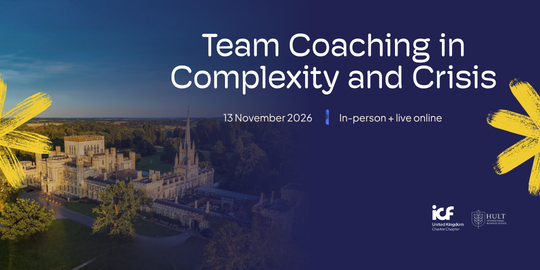
Team Coaching in Complexity and Crisis brings leading thinkers and practitioners together
READ MORE
The reflections shared through this initiative will help share future supervision provision.
READ MORE

Over two days in early November, as the co-president of UK ICF Chapter, I had the privilege of attending Thinkers50 Summit
READ MORE
It's about noticing what constrains and what expands... shedding what confines, and cultivating what is both grounded and spacious
READ MORE
Getting together as ICF chapter leaders is important for building cross-border coaching communities and strengthening our chapter networks across geographies
READ MORE
A day alive with fresh thinking, learning, and connection.
READ MORE
The Coach's Summer Playbook: Grow While You Recharge
READ MORE
The conversation around AI in coaching is heating up.
READ MORE
Uncertainty has a way of stretching us... requiring us to ideate, iterate and adapt at pace, and develop resilience and innovation along the way...
READ MORE
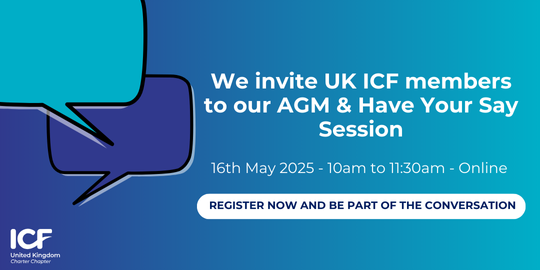
Join Us for the UK ICF Annual General Meeting - Have Your Say
READ MORE
Change is an inevitable part of life, and every transition brings its own set of challenges and opportunities.
READ MORE
As a member of both ICF Global and the UK ICF Chapter, you have direct access to a diverse range of resources.
READ MORE
Reflections from ICF CIO Connection Day 2025
READ MORE
Meet Guy Buckingham, the UK ICF's newly appointed Co-President!
READ MORE
Meet Szilvia Hock-Kovacs, our Associate Board Member for Recruitment!We are excited to introduce our next member this week, Szilvia, who has joined our board as a volunteer focusing on recruitment! H...
READ MORE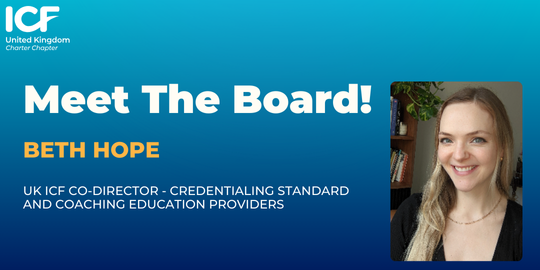
Get to know more about Beth Hope, UK ICF Co-Director for Credentialing Standard and Coaching Education Providers
READ MORE
Coaching at the Heart of Transformation: Navigating Change, Empowering Growth, Shaping the Future
READ MORE
Get to know more about Panos Malakoudis, UK ICF Co-Director for Credentialing Standard and Coaching Education Providers
READ MORE
Coaching, Community, and Care: Supporting Coaches to Make a Difference
READ MORE
Magazine: Wellbeing and self-care for coaches: A summer of rest and self-renewal
READ MORE
Magazine: Beyond ‘walking and talking’ - Coaching in Relationship with Nature
READ MORE
UK ICF Collaborative Partnership with Scientists from the Microbiology Society
READ MORE
Magazine: Using the Spring as a Springboard to Wellness
READ MORE
Magazine: Quick Tips To Look After Yourself As A Coach
READ MORE
Magazine: Is the Future of Coaching Visual?
READ MORE
Magazine: Become an RSA Fellow & benefit from a range of opportunities as a coach
READ MORE
Magazine: State of Coaching in Organisations
READ MORE
Magazine: How Much Marketing Do You Need to Do?
READ MORE
Magazine: Coaching then and now – a look back over 21 years
READ MORE
Magazine: Creating a new world - 7 key strategies to generate sustainable and long-lasting change
READ MORE
Magazine: Is it time to be meaningfully more human in the age of AI?
READ MORE


Living with uncertainty is a theme that comes up again and again
READ MORE


