


Coaches have been taking their practice outside for a long time. Many of us have experienced the benefits of ‘walking and talking’ with our clients - just as teams and managers are reporting the space, creativity and innovative thinking that can come from meeting in the fresh air. https://www.entrepreneur.com/growth-strategies/7-benefits-of-outdoor-meetings/452277
But recent research, and a landmark gathering of ‘outdoor coaches’ in July, point to a richer way of coaching. One which is about mutually beneficial relationships - with ourselves, and our clients, of course, but also the planet we depend on.
The sold out gathering, at Henley Business School, was quite possibly a world first. Hosted by the Coaching Outdoors Podcast, this ‘live festival’ was packed with a dizzying array of coaching approaches. Practitioners working with the ocean, team systems, mindfulness, embodiment, nature play, nature connection, adventure and more. It felt, as James said afterwards ‘the start of a new movement.’ https://www.linkedin.com/feed/update/urn:li:activity:7219285650380910594/
Nature is good for us
‘We all need nourishment for our psyche. It is impossible to find such nourishment in urban tenements without a patch of green or a blossoming tree.’ Carl Jung, pub 1987
Though many of us might not need the science to tell us being in nature feels good, there are clear benefits. Safe, natural surroundings activate parts of our nervous system that help us feel calmer, think creatively, and make more ethical decisions. Connecting to the natural world boosts self esteem, life satisfaction and positive emotions. Put simply, living a nature disconnected life can mean a life that is unhappier, shorter and sicker. And that’s according to the British Medical Journal.
I bet your clients would want to receive these benefits. I bet you would too.
Coaching with nature
“What is the pattern that connects the crab to the lobster and the orchid to the primrose, and all four of them to me? And me to you?" Gregory Bateson, 1979
The facilitators at Henley would all agree that the coaching work itself benefits too. There is an abundance of natural metaphors to explore. An increased sensory palette. A precious lack of judgement, which enables us to take greater risks. Work by Alex Burn and Professor Jonathan Passmore has shown that step synchrony and working in a natural space offers firm benefits in line with Attention Restoration Theory.
Natural coaching can offer deep levels of awareness and learning – and ensure that the planet and its needs form part of the context for setting options and actions. Some of that action may well be returned to nature. As we get to know ourselves better through a natural coaching approach, we also have the opportunity to get to know the environment around us better. To deepen our relationship with ourselves, other people and nature.
The growing movement is global. It includes trailblazers within this space like Michael Jospe from the Earth Based Institute in Colorado, who works within ICF frameworks, and Tabitha Jayne in Scotland, who also works within ICF, but has modified the competencies to incorporate an earth conscious mindset. There are a wide range of terminologies and languages, as one would expect from an emergent movement. Outdoor coaching. Climate coaching. Eco-coaching. Green coaching. Nature coaching. Nature based coaching. Earth based, or earth conscious coaching. Some practitioners work with nature as more of a ‘container’ for the coaching. Others work more as a facilitator for a dialogue between client and nature - which Geratz, Papworth & Palmer (2024) described in a recent paper as ‘like walking with a friend’. This is partnering at a deeper level.
It is clear from Henley, and the 70 hours of podcasts already recorded by Coaching Outdoors Podcast, that the work is hugely diverse. It can be urban, suburban, even in wilderness. For short periods, or long. We can work with nature as a ‘stakeholder’ in a traditional indoor setting, as Peter Hawkins advocates. We can embrace both conscious and unconscious, emergent approaches to nature connection. We can be still, or active.
We must, of course, consider the psychological and physical safety of working outside - as well as the cultural and sociopsychological needs of different communities, and of our clients. Some clients will lack access to nearby natural greenspace, or not feel welcome or safe there. Nature coaches that wish to bring their work to more urban communities, and clients from global majorities, will need to contract with extra curiosity and sensitivity.
Diagram: Nature, location, movement and time coaching spectrum
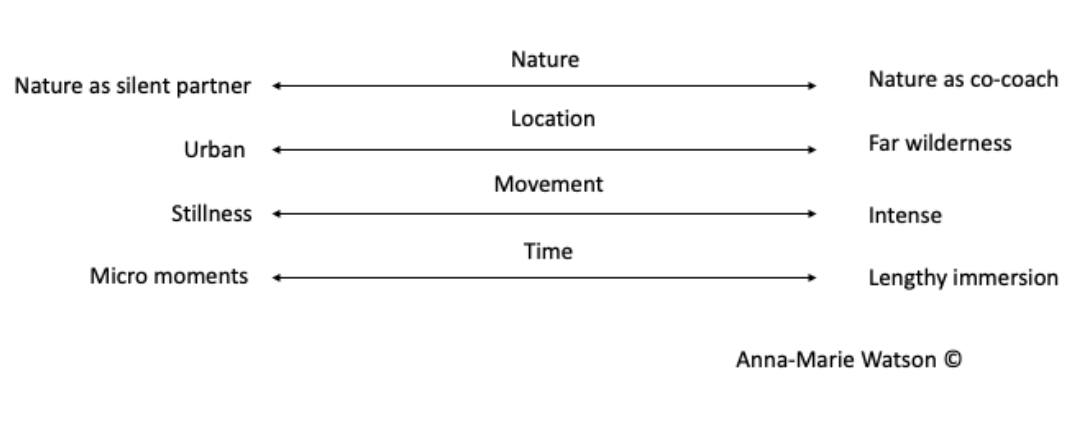
And finally - as for any practice we wish to bring to our clients - we must cultivate our own mindset and relationship with nature. What is your relationship with nature?
What is ours to do?
‘It would seem then that, ultimately, we each have to serve as judge and jury for our own actions. And that cannot happen unless we develop an affection for Nature and its processes.’ Partha Dasgupta, 2021.
Carl Rogers believed that change comes about ‘through experience in a relationship’. In this case there is an additional relationship that comes to the forefront - our relationship with nature.
Recent research from Seattle has shown that people rate their relationships with companions and strangers more highly after time in a natural green space. Psychologists from University of Derby have suggested five pathways we can follow to a closer relationship with nature - senses, emotion, beauty, meaning and compassion - which can be mapped onto coaching competencies. And various studies have shown that people who report feeling this deeper relationship, i.e. feeling ’nature connected’, also report up to twice as much day to day action that benefits the environment, and almost twice as much action that benefits nature.
Four years ago, the ICF signed the Global Statement on Climate Change. It recognises the interconnectedness of climate and biodiversity, and all species and earth systems. It calls for action. Nature coaching is part of the response. It is a way for the coaching profession to help contribute meaningfully to the climate and nature emergencies, as well as bringing benefits for health and wellbeing.
What then, is ours to do? Here are some suggestions for next steps you might like to consider, adapted from Peter Hawkins, James Farrell and Diana Tedoldi.
Find a place that feels safe, preferably in a natural green or blue space, and get comfortable.
Focus on the ‘more-than-human world of the wider ecology, that provides more the 99% support of what supports our lives’.
Feel your environment with your senses. Feel your emotional response to being in relationship with nature.
Ask yourself, What is meaningful to me about this moment? What would the natural world say is the work I need to do?
References
James Farrell - Fully committed to doing good things for people and planet with a blend of roles - leadership and mental health coach, nature connected organisations consultant, and public sector manager. He is also an author, TEDx speaker, and film maker. James is passionate about how coaches can facilitate mutually-beneficial human-nature connections.
Website: https://naturalcoachingcompany.com/about/
LinkedIn: https://www.linkedin.com/in/jfarrell1/
Anna-Marie Watson - Happiest outdoors Anna-Marie is a Coach, Supervisor and ‘Coaching Outdoors’ Podcast co-host. Former Army Officer and professional endurance athlete, she is on a mission to encourage coaches to step outdoors. She contributed to ’The Coaches Handbook’ and ‘Succeeding as a Coach’ and has spoken on the topic for the Association for Coaching, British Psychological Society, International Coach Federation and Henley Business School events.
Website: https://www.rfmcoaching.com/
Website: https://coaching-outdoors.com/
LinkedIn: https://www.linkedin.com/in/awatson4/


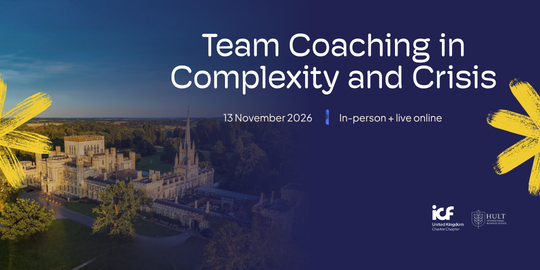
Team Coaching in Complexity and Crisis brings leading thinkers and practitioners together
READ MORE
The reflections shared through this initiative will help share future supervision provision.
READ MORE
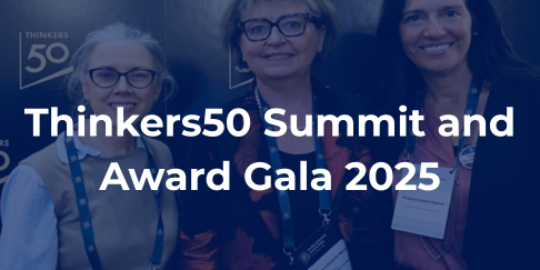
Over two days in early November, as the co-president of UK ICF Chapter, I had the privilege of attending Thinkers50 Summit
READ MORE
It's about noticing what constrains and what expands... shedding what confines, and cultivating what is both grounded and spacious
READ MORE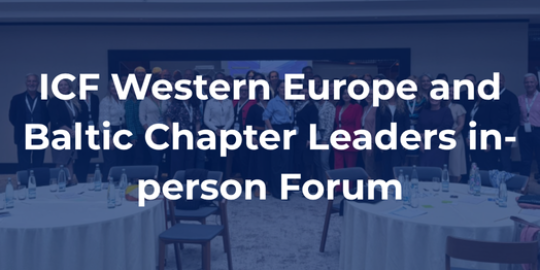
Getting together as ICF chapter leaders is important for building cross-border coaching communities and strengthening our chapter networks across geographies
READ MORE
A day alive with fresh thinking, learning, and connection.
READ MORE
The Coach's Summer Playbook: Grow While You Recharge
READ MORE
The conversation around AI in coaching is heating up.
READ MORE
Uncertainty has a way of stretching us... requiring us to ideate, iterate and adapt at pace, and develop resilience and innovation along the way...
READ MORE

Join Us for the UK ICF Annual General Meeting - Have Your Say
READ MORE
Change is an inevitable part of life, and every transition brings its own set of challenges and opportunities.
READ MORE
As a member of both ICF Global and the UK ICF Chapter, you have direct access to a diverse range of resources.
READ MORE
Reflections from ICF CIO Connection Day 2025
READ MORE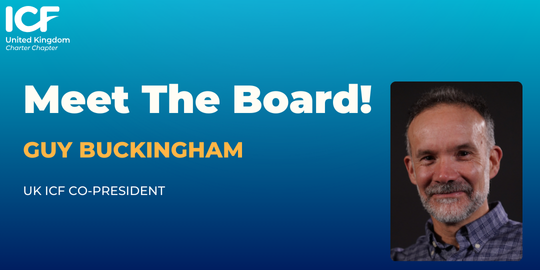
Meet Guy Buckingham, the UK ICF's newly appointed Co-President!
READ MORE
Meet Szilvia Hock-Kovacs, our Associate Board Member for Recruitment!We are excited to introduce our next member this week, Szilvia, who has joined our board as a volunteer focusing on recruitment! H...
READ MORE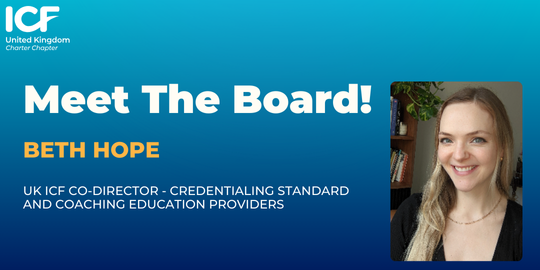
Get to know more about Beth Hope, UK ICF Co-Director for Credentialing Standard and Coaching Education Providers
READ MORE
Coaching at the Heart of Transformation: Navigating Change, Empowering Growth, Shaping the Future
READ MORE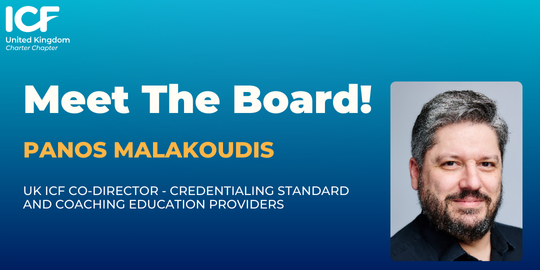
Get to know more about Panos Malakoudis, UK ICF Co-Director for Credentialing Standard and Coaching Education Providers
READ MORE
Coaching, Community, and Care: Supporting Coaches to Make a Difference
READ MORE
Magazine: Wellbeing and self-care for coaches: A summer of rest and self-renewal
READ MORE
UK ICF Collaborative Partnership with Scientists from the Microbiology Society
READ MORE
Magazine: Using the Spring as a Springboard to Wellness
READ MORE
Magazine: Quick Tips To Look After Yourself As A Coach
READ MORE
Magazine: Is the Future of Coaching Visual?
READ MORE
Magazine: Become an RSA Fellow & benefit from a range of opportunities as a coach
READ MORE
Magazine: State of Coaching in Organisations
READ MORE
Magazine: How Much Marketing Do You Need to Do?
READ MORE
Magazine: Coaching then and now – a look back over 21 years
READ MORE
Magazine: Creating a new world - 7 key strategies to generate sustainable and long-lasting change
READ MORE
Magazine: Is it time to be meaningfully more human in the age of AI?
READ MORE

Living with uncertainty is a theme that comes up again and again
READ MORE


