
Over the past decade, I have noticed a significant shift in how organisations define effective leadership. Increasingly, leaders are not being asked simply to deliver results or manage performance; they are being asked to develop people’s thinking, confidence, and capability.
My perspective on this has been shaped by two different but closely connected experiences. I spent more than 35 years working inside large organisations, leading businesses and teams across operations, HR, finance, property and audit. Today, as an ICF Master Certified Coach and coach educator, I work with senior leaders and organisations across sectors, helping individuals and teams navigate change, transition and increasing complexity. Having experienced leadership from both sides of the conversation, I have become increasingly convinced that the ability to coach is becoming one of the defining capabilities of effective leadership.
In my experience as both an executive coach and coach trainer, this shift reflects something deeper than changing leadership fashions. It signals a growing recognition that traditional leadership approaches alone are no longer sufficient for the complexity of modern work.
Leadership is evolving and coaching skills are becoming central to that evolution.
Historically, many leadership models were shaped by stability and hierarchy. Leaders were expected to provide answers, make decisions quickly, and direct activity. Expertise and authority were closely linked.
Today’s organisational environments are markedly different. Leaders operate amid uncertainty, rapid change, hybrid working, and increasingly specialised teams. Often, the people closest to the work hold more situational knowledge than the leader themselves.
In these contexts, the leader’s role begins to shift from providing solutions to enabling effective thinking.
In my work with senior leaders and leadership teams, this is one of the shifts I see most consistently. Leaders are often managing people with deeper technical expertise than their own, across different geographies, generations and working patterns. The challenge is no longer simply knowing what to do; it is creating the conditions in which other people can think well, contribute fully and take genuine ownership. This is where coaching skills become particularly valuable.
Coaching does not remove leadership responsibility; rather, it expands how leaders support performance and growth simultaneously.
When I work with leaders learning coaching approaches, one of the first realisations is that coaching is less about techniques and more about attention to how leaders listen, respond, and create space for reflection.
Over the years, my work with leaders and coaches has led me to think about coaching-informed leadership through five interconnected practices: deep listening, insightful questioning, empowered problem-solving, ownership and accountability, and psychological safety.
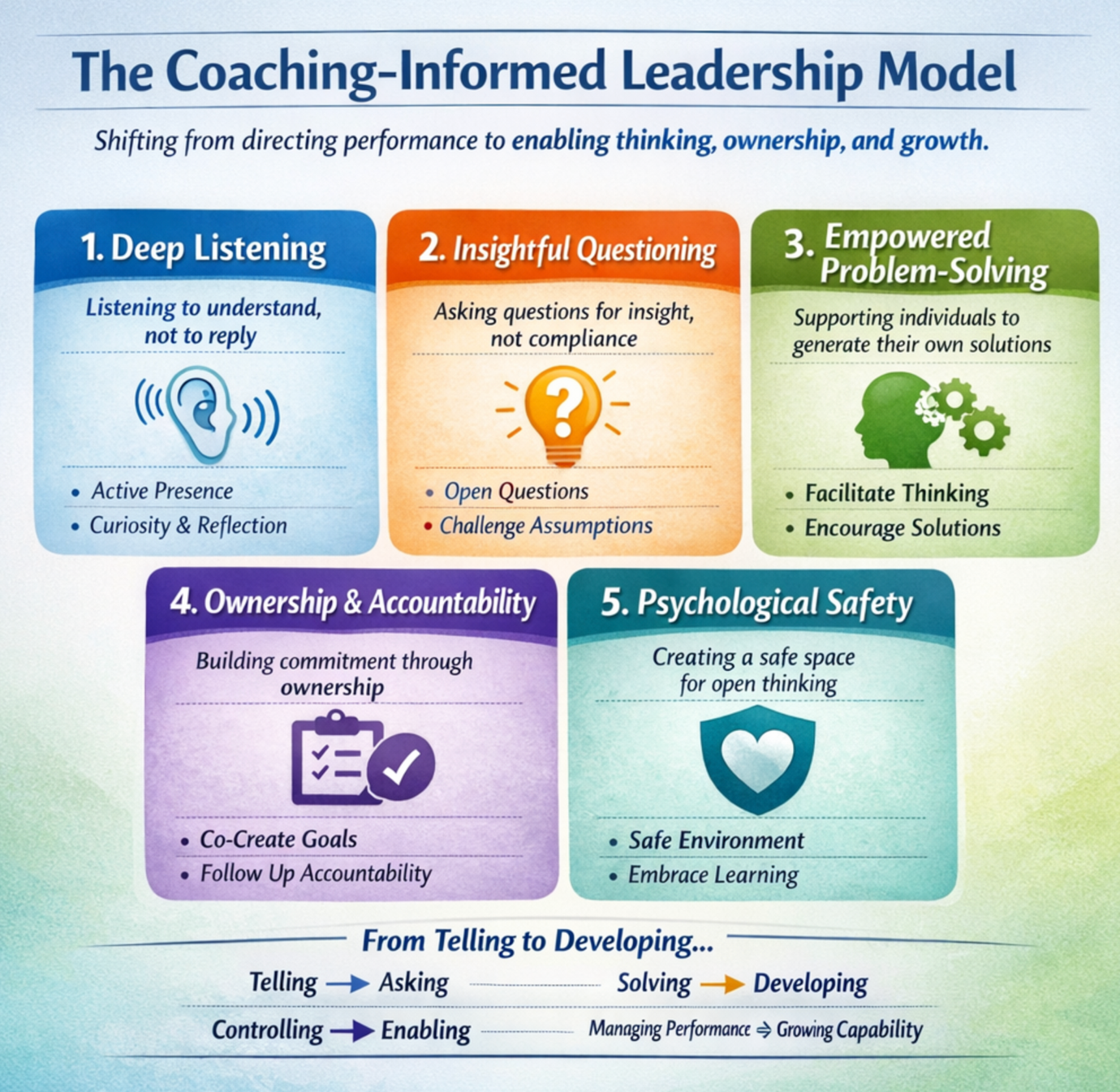
None of these behaviours is especially complicated in isolation. The challenge is practising them consistently, particularly when the pressure is on and the temptation to provide the answer is strongest.
In my experience, when leaders shift from telling to asking, something important happens: people begin to think more independently. Over time, this strengthens confidence, judgement, and responsibility within teams.
I have seen this shift play out many times in my work with senior leaders. One executive I worked with had built a successful career by being decisive, knowledgeable and quick to solve problems. Those strengths had served them well, but as their responsibilities grew, they had unintentionally become the person to whom every difficult decision was escalated. Our work was not about making them less decisive. It was about helping them become more intentional about when to provide an answer and when to create the space for others to think. Over time, the quality of their conversations changed, their team took greater ownership, and the leader was able to spend more time operating strategically rather than solving problems that others were capable of resolving.
Organisations are increasingly investing in coaching capability among leaders. Here is what I have observed:
Modern challenges rarely sit within a single function or expertise area. Leaders who rely solely on directive approaches may unintentionally limit the intelligence available to them.
A coaching approach invites broader thinking. By encouraging exploration and reflection, leaders access perspectives that might otherwise remain unheard.
This often leads to more sustainable solutions because they are collectively understood rather than individually imposed.
Many leadership challenges today relate not to competence but to engagement. People want meaningful contribution and a sense of agency in their work.
Coaching conversations can support this by helping individuals clarify goals, recognise strengths, and take ownership of decisions.
In my experience, engagement tends to increase when people feel trusted to think rather than instructed to comply.
Organisations frequently invest heavily in formal development programmes, yet much learning occurs informally.
Leaders who adopt coaching skills turn routine interactions — one-to-ones, project discussions and feedback conversations — into moments of development.
Over time, this creates a culture where learning is continuous rather than event-based. Here is what it takes.
One of the most common challenges leaders describe when learning coaching skills is the discomfort of not immediately providing answers.
I understand this discomfort personally. For much of my corporate career, I was rewarded for having answers, making decisions and solving problems. Many of the senior leaders I now coach have followed a similar path. Expertise helped them progress, so it is entirely understandable that stepping back, staying curious and resisting the urge to solve can initially feel counterintuitive.
The paradox is that, as leadership responsibility grows, being the person with all the answers can become a constraint. Leaders who create dependency become bottlenecks; leaders who build thinking capability create capacity.
Leaders often report that coaching reduces dependency. When individuals develop stronger thinking skills, fewer problems escalate upward.
In my experience, leaders begin to move from being the central source of solutions to becoming facilitators of capability. This often results in stronger teams and more sustainable performance.
It is important to distinguish between professional coaching and coaching-style leadership.
There remain situations where directive leadership is entirely appropriate, such as crisis response, compliance requirements, or time-critical decisions. Coaching is not a universal substitute for leadership judgement.
Rather, it broadens the leader’s range of responses.
A useful reflection I often share with leaders in training is:
The ability to choose intentionally is what differentiates mature leadership practice.
From my perspective, coaching skills are becoming essential because organisations increasingly depend on adaptability, learning, and human capability rather than hierarchy alone.
Leaders who create environments where people can think well, challenge constructively, and learn continuously are better positioned to navigate uncertainty — all outcomes which coaching supports.
Coaching supports these outcomes not through motivation techniques or performance pressure, but through structured conversation and genuine curiosity.
In my experience, the most effective leaders today are those who measure success not only by what they achieve themselves, but by the capability they build in others.
Leadership, therefore, is not being replaced by coaching.
It is being refined by it.
And perhaps the defining shift for modern leadership is this: the leader’s role is no longer simply to provide direction, but to create the conditions in which others can think, grow, and perform at their best.


From Coach to Coaching Professional: What Separates Accreditation from Capability?
READ MORE
A Guide to understanding the broader landscape of somatic coaching
READ MORE
Why Attention Is the New Executive Superpower - And How Coaches Can Help...
READ MORE
5 Coaching Metaphors Backed by Neuroscience That Unlock Awareness
READ MORE
From Failure to Master Certified Coach: 7 Lessons That Changed Everything
READ MORE


