
When I first encountered somatic coaching, it was not through theory. It was through the simple but profound discovery that the body often knows something before the thinking mind can explain it.
As someone with ADHD, I have always been sensitive to non-verbal communication: facial expression, tone of voice, body language and gesture. Through partner work, I also experienced that we are not nearly as separate as we appear, and that what I feel in my body is sometimes related to what is happening within the body of another!
Yet in the coach trainings I completed, I felt something was missing. There was little attention given to the body as a source of intelligence. So I trained in somatics and body psychotherapy, and began integrating those learnings into my coaching practice. The Somatic School was born out of the desire to create the coach training I had been searching for.
One of my favourite books is Original Wisdom by Robert Wolff. Wolff lived with the Orang Asli people of Malaysia and wrote about their extraordinary sensory and intuitive capacities. What appears supernatural, he argues, is as natural as it gets. For me, this points to something essential: embodied ways of knowing are not special powers to acquire, but human capabilities to remember.

Somatics encompasses a vast array of approaches united by one common thread. They all involve the body, yet differ enormously in lineage and method.
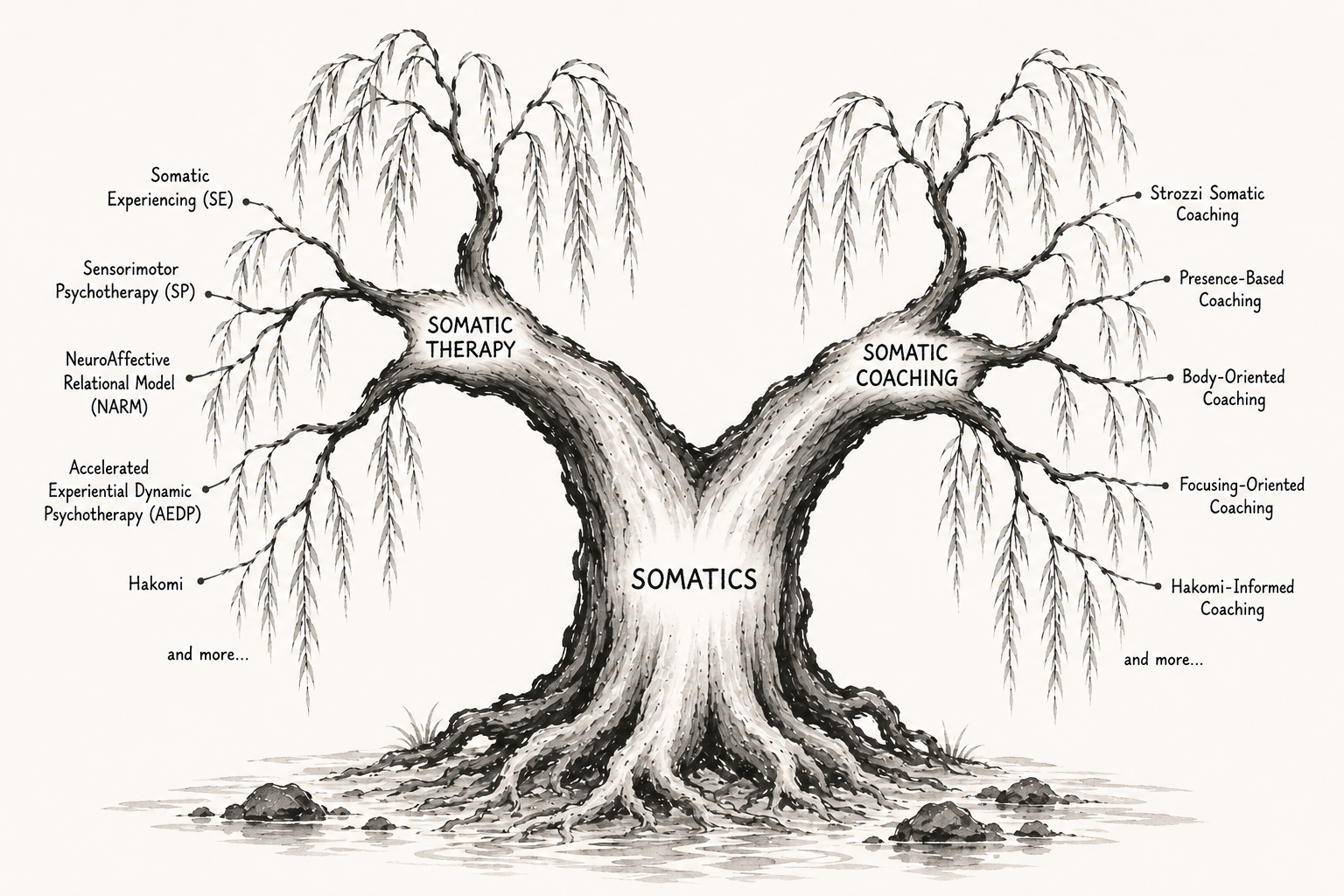
If we imagine somatics as the trunk of a great willow tree, then somatic therapy and somatic coaching are two major branches growing from that trunk - each branch continuing to divide into distinct schools of practice.
Somatic Coaching is a term that has become increasingly widespread. However, like “somatic therapy”, it does not refer to a single method. That’s what we mean when we say Somatic Coaching is an umbrella term.
Under this umbrella sits Body-Oriented Coaching - a distinct modality that is process-oriented, body-centred, influenced by whole systems thinking, and grounded in relational presence. It integrates the intelligence of the body with the core competencies of professional coaching, allowing coach and client to work with the whole human being.
Somatic coaching owes a great deal to body psychotherapy, which has incorporated the body for over sixty years and draws from Eastern philosophies, Gestalt, Humanistic psychology, psychoanalysis, bodywork and movement.
The body has only relatively recently been embraced within coaching. For over 40 years, Strozzi Somatic Coaching was essentially the only widely recognised form of somatic coach education. Later, other approaches emerged, including Presence-Based Coaching, Ontological Coaching and Body-Oriented Coaching.
That is why clarity matters.
As a somatic coaching modality, Body-Oriented Coaching is distinct in three key ways.
Many approaches that call themselves “somatic coaching” drift toward therapeutic territory: becoming more directive, assessing and prescribing, or prioritising discharge, catharsis, or emotional release.
Body-Oriented Coaching stays rooted in an ICF-aligned coaching stance: non-directive, partnering, client-led process, attunement over interpretation, and emergence over corrective intervention.
Rather than saying, “Your tight shoulders mean you are carrying responsibility,” a Body-Oriented Coach might ask, “As you say that, what do you notice happening in your body?” The client remains the author of their own meaning.
Many somatic trainings focus on tools: techniques, protocols, or structured somatic exercises.
But here’s the truth shared by modalities like Hakomi, Focusing, Gestalt, and Organic Intelligence®, which Body-Oriented Coaching draws upon: the technique only works if the conditions are right.
The real engine of transformation is not the tool - it’s the conditions the practitioner cultivates: nervous system capacity, relational safety, attunement, non-interference, and an orientation toward emergence.
In practice, this might mean slowing down when a client feels stuck, inviting them to notice where that stuckness lives in the body, or what becomes possible when it is met in presence.
Body-Oriented Coaching is informed by Interpersonal Neurobiology, 4E Cognition, Affective Neuroscience, Polyvagal Theory and Systems Thinking.
The worldview is simple yet profound: human beings are complex living systems. Change does not come from controlling outcomes, but from supporting the conditions for self-organisation to unfold.
A small shift in breath, posture, attention or awareness can open a new way of seeing.
Without these distinctions, the field becomes blurry, confusing, and ethically risky.
Some “somatic coaching” approaches mimic therapy, some trauma-oriented programmes teach methods inappropriate for coaching, and many newer offerings ignore the deeper lineage.
Clarity protects clients. Clarity strengthens practitioners. And clarity elevates the entire field.
Body-Oriented Coaching contributes something vital to that clarity: a way of working somatically that is ethical, rigorous, embodied, relational, processual and distinctly coaching.
Hopefully, it might be this: somatic coaching is an umbrella term.
Body-Oriented Coaching is a specific modality under that umbrella.
Its contribution is not simply that it brings the body into coaching, but that it does so in a way that preserves the heart of coaching itself: partnership, presence, curiosity, and trust in the client’s own unfolding.
Perhaps you, too, feel called to bring the “whole” back into “creative, resourceful and whole.”
If so, may your journey of remembering begin today.


From Coach to Coaching Professional: What Separates Accreditation from Capability?
READ MORE
The Leader as Coach: Why Coaching Skills Are Becoming Essential for Modern Leadership
READ MORE
Why Attention Is the New Executive Superpower - And How Coaches Can Help...
READ MORE
5 Coaching Metaphors Backed by Neuroscience That Unlock Awareness
READ MORE
From Failure to Master Certified Coach: 7 Lessons That Changed Everything
READ MORE


