
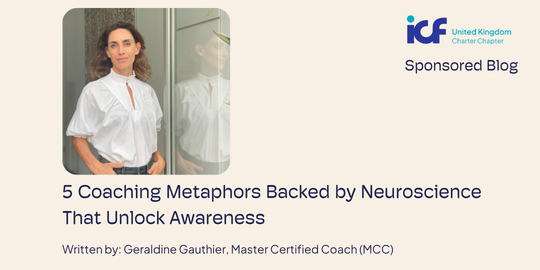

As a Master Certified Coach (MCC), metaphors are central to my work. People rarely arrive with neat, linear explanations of their challenges. They arrive with sensations, tensions and images. Metaphors provide a bridge from the abstract to the tangible. In fact, when I train coaches on how to effectively use coaching tools, metaphors become one of the most versatile ones because they invite clients to feel their world instead of just talk about it.
Neuroscience backs up this intuition: studies show that when people hear a metaphor such as “she had a rough day”, their brain activates the same tactile regions involved in actually feeling rough surfaces; hearing action verbs used metaphorically, such as “grasp a concept,” engages sensory-motor regions much like a literal action. We use metaphors so naturally, researchers estimate we employ one roughly every 20 words that meeting clients in this language feels like speaking their mother tongue.
Every image a client shares is a doorway into their inner world.
Below are five metaphors I frequently encounter in coaching, along with examples and tips on how to use them.
A client once said, "My life feels like a boat taking on water."
I asked, "Where is your boat right now: harbour, open sea, or storm?"
Tip: Boats reveal how your client sees support and control. Are they steering? Do they have a crew? Is the weather calm or chaotic?
Psychologist Scott Barry Kaufman offers the sailboat metaphor as a reflective tool for yourself or your clients.
A coachee came in saying, "It feels like an emotional downpour today."
I asked, "What's your shelter?"
A manager once described standing before a heavy door: "I want to open it, but I'm scared of what's on the other side."
We explored the handle, the weight, the unknown. In the end, she said, "Even if I don't know the full room, I can open it just a crack." That small step turned hesitation into movement.
Tip: Doors invite curiosity. What if the door isn't locked? Could there be a light or support on the other side?
A client described feeling "stuck in a small, dark room"
I asked about the walls, the windows, the furniture. She suddenly laughed: "There's a window - I just never opened it." Imagining pulling the curtains shifted her from trapped to resourceful. The metaphor helped her see possibilities she hadn't noticed.
Tip: Rooms represent mental spaces. Ask about size, light, contents. Are there multiple rooms? A door to exit.
Another described her workplace as a jungle: "Snakes and gorillas everywhere."
She paused, then added, "Actually, I do have allies - birds that guide me". Seeing the organisation as an ecosystem - not just predators - gave her a new way to survive and even thrive.
Tip: Jungles capture complexity. Invite clients to see predators and allies. What resources are hidden among the vines?
1. Notice them. Clients often drop metaphors unconsciously: "I feel like I'm drowning", "It's a jungle out there", "I hit a wall". Catch these phrases and bring them to awareness.
2. Stay curious. Don't translate too quickly. Ask open questions about the metaphor’s sensory qualities (sights, sounds, textures), emotional tone and hidden elements. Neuroscience suggests that exploring these sensory details activates embodied understanding.
3. Invite exploration. Encourage clients to walk around their metaphor. If it's a house, what's in each room? If it's a forest, are they lost or exploring? If it's a board, who else is on board?
4. Avoid imposing your own metaphor. Every brain has unique associations. Imposing a metaphor risks misalignment. If a metaphor seems limiting, offer an alternative with permission: "Would you like to explore another image that might offer new possibilities?"
5. Anchor the shift. When a metaphor evolves ("the storm is clearing", "I see light"), link it to action: What will you do differently now? This integrates insight with behaviour.
6. Offer a metaphor (carefully). Sometimes clients are stuck in story-less data. Gently offer a metaphor - "Would it help to think of this as climbing a mountain?" - and check if it resonates. If it doesn't, let it go.
Clients may forget my questions, but they never forget the images.
That's the quiet, profound work of metaphor. As neuroscience shows, these images engage sensory areas of the brain and light up our motor cortex. They connect head, heart and body: an essential integration for lasting change. Growth starts when we notice the story we're standing in.
At the MCC level, metaphors are not optional; they are the heart of the transformation.
Geraldine Gauthier, MCC
Founder, GoMasterCoach
Master Certified Coach & ICF Accredited Trainer

This article is a paid sponsored blog, published in partnership with Geraldine Gauthier. Sponsored blogs provide experienced practitioners with an opportunity to share coaching-relevant insights with the UK coaching community, in line with UK ICF's editorial and ethical standards.


From Coach to Coaching Professional: What Separates Accreditation from Capability?
READ MORE
The Leader as Coach: Why Coaching Skills Are Becoming Essential for Modern Leadership
READ MORE
A Guide to understanding the broader landscape of somatic coaching
READ MORE
Why Attention Is the New Executive Superpower - And How Coaches Can Help...
READ MORE
From Failure to Master Certified Coach: 7 Lessons That Changed Everything
READ MORE


