
I became a Master Certified Coach in June 2024. But first, I failed my first assessment, I was crushed. I sat staring at the feedback, feeling like a fraud. How could I train other coaches when I couldn't even pass this myself?
But I refused to give up. I hired the best ICF mentor coaches I could find and I studied everything from Marcia Reynolds and Marion Franklin.
And slowly, I learned what mastery actually means. What I discovered transformed not just my coaching, but who I am as a coach.
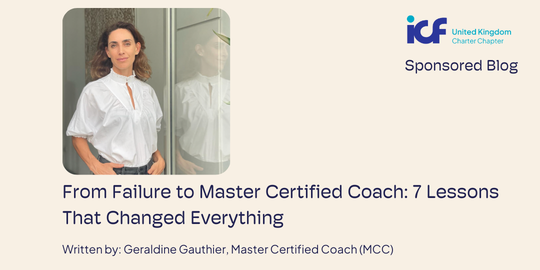
I'm Geraldine Gauthier, an executive coach. I've been coaching for over 20 years, first as a manager empowering my team with a coaching mindset, then as an executive coach, and since 2019 as a founder of GoMasterCoach, where I train coaches for their ICF credentials.
Here are the 7 lessons and practical insights that got me there:
Stop getting lost in your client's stories:
That's not what you're coaching. You're coaching who they are in relation to all of that. That's what I learned from Marcia Reynolds. This fundamental shift changed everything for me.
Instead of: "What's your strategy for dealing with this difficult board member?"
Try: "What do you believe about yourself when you're in that boardroom?"
Instead of: "How can you improve your team's performance?"
Try: "What does being a leader mean to you? And what does that show up or not show up with your team right now?"
I had a CEO client in Bangkok who kept talking about strategy issues. Week after week: the competition, the market shifts, the product roadmap. All very intellectual. All very safe.
When I shifted to "Who do you need to be to lead this change?" everything stopped.
He went quiet. Then he said "I need to be someone who admits I don't have all the answers. But I've built my entire career on being the smartest person in the room."
We stopped talking about the problem and started talking about him. About the belief that had driven his success and was now limiting him. About the fear beneath the strategy decisions.
Master coaches are like detectives. You're not just listening to words, you're reading the entire person.
Watch for:
Last week a client said "I'm fine with it" while her jaw was clenched and her arms were crossed. Her whole body was screaming the opposite.
I said, "You say you're fine, but your body seems to be saying something different."
Long pause. "You're right. I'm furious actually. And I've been telling myself I shouldn't be."
That's the real conversation. Not the polished version they came prepared to discuss.
Be honest about what you're noticing. This is scary at first because you might be wrong.
Be wrong sometimes. It's better than staying silent.
"Your voice just changed when you mentioned your team."
"You lit up talking about that project, but now you seem deflated."
"You've mentioned your father three times in the last five minutes."
Don't analyse them. Don't interpret. Just reflect what you observe.
Then shut up and see what happens.
Start with the body. It's easier and less threatening.
"I noticed your shoulders just dropped." "Your hands are clenched." "You're sitting forward now, different from how you started."
Master this, then move to emotions and patterns.
Silence used to terrify me. I'd rush to fill it with another question, another reflection, anything to avoid the discomfort.
The most powerful thing you can say is nothing at all.
Let silence do the heavy lifting: wait.
Your client needs time to:
The best insights come from silence.
Me: "What are you most afraid of if you make this change?"
Client: "I don't know..." [pause]
Me: [Silence. Fighting every urge to rescue them.]
Client: [After 15 seconds] "Actually...I think I do know. I'm afraid I'll succeed. And then everyone will expect me to keep succeeding at that level forever."
That answer wasn't available in the first three seconds. It needed silence to emerge.
And yes, 10 seconds of silence feels eternal. Do it anyway.
"I hear how hard this is for you."
"I see the courage it took to say that."
Simple acknowledgement builds trust faster than anything else.
Praise: "You're doing great!" (evaluation)
Acknowledgement: "I see how much effort you're putting into this." (observation)
Praise: "That was brave!" (judgement)
Acknowledgment: "I imagine that took courage to share." (witnessing)
You're not praising them. You're just seeing them clearly and letting them know you see them.
A client started crying in our session. First time in two years of working together.
I didn't say "It's okay" or "Don't cry" or try to make her feel better.
I said: "I'm here. Take your time."
After a minute, I added: "I see how much this matters to you."
She nodded, wiped her eyes, and said, "Thank you for not making it weird."
That's when people feel safe enough to go deeper.
Don't assume you know what your client discovered. Don't tell them what they learned.
Ask:
When they say it out loud, it becomes real for them. It moves from your observation to their ownership.
This was huge for my MCC assessment.
In my first attempt, I was constantly reflecting back what I thought the client was learning: "So it sounds like you're realising you need to set boundaries..."
The assessor noted: "Coach is doing the learning for the client."
Ouch. True
In my second attempt, I asked: "What are you discovering about yourself right now?"
And the client said something I never would have guessed. Something more profound than anything I could have reflected back.
Throughout the session, link things together. Help your client see patterns they can't see themselves.
"Earlier you said X. How does that connect to what you're seeing now?"
"You mentioned fear at the beginning. Is that showing up here too?"
"You came in wanting clarity about your next move. What's clear now?"
"What shifted for you in this conversation?"
Help them see the journey they just took. That's when they realise how far they've come.
A client started a session saying she needed to decide between two job offers.
45 minutes later, she was talking about her relationship with her mother and her pattern of seeking approval.
I said: "When we started, you were choosing between two jobs. Now you're talking about approval-seeking. How do these connect?"
She lit up: "Both these jobs are what other people think I do. Neither is what I actually want. I can believe I didn't see that."
She didn't take either job. She created a third option that was actually hers.
Getting MCC certified isn't about passing a test. It's about changing how you show up.
It's about:
Failing my first attempt taught me all of this. I thought I was being a great coach. The recording showed otherwise. I was asking good questions, but I wasn't really listening as I was so busy planning my next move. Now I have:
deep presence, real curiosity, and trust in the process.
At GoMasterCoach, I now help other coaches prepare for their ICF credentials. I bring everything I learned from falling flat on my face.
Because I'm still learning. Still noticing things I miss.
That's the paradox. The more you learn about coaching, the more you realise how much you don't know.
So, pick one of these seven lessons. Practice it deliberately in your next three sessions.
Notice what happens: what's hard, what opens up.
And when you mess it up: good. That's where your learning starts.
Geraldine Gauthier, MCC
Founder, GoMasterCoach
Master Certified Coach & ICF Accredited Trainer

This article is a paid sponsored blog, published in partnership with Geraldine Gauthier. Sponsored blogs provide experienced practitioners with an opportunity to share coaching-relevant insights with the UK coaching community, in line with UK ICF's editorial and ethical standards.


From Coach to Coaching Professional: What Separates Accreditation from Capability?
READ MORE
The Leader as Coach: Why Coaching Skills Are Becoming Essential for Modern Leadership
READ MORE
A Guide to understanding the broader landscape of somatic coaching
READ MORE
Why Attention Is the New Executive Superpower - And How Coaches Can Help...
READ MORE
5 Coaching Metaphors Backed by Neuroscience That Unlock Awareness
READ MORE


